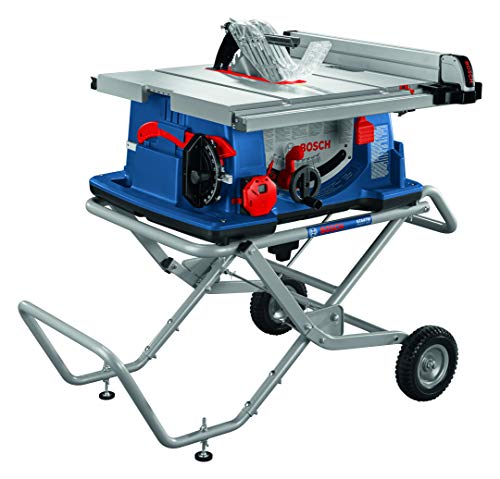
The Bosch 4100XC-10 is a 10-inch worksite table saw with a wheeled stand, a 15-amp motor and a rip fence that Bosch says is engineered for trueness and ease of use. It belongs to the class of jobsite saws that also work in a home garage: light enough to move, wide enough to rip a sheet of plywood in half. This profile covers what Bosch says about the saw, what its numbers mean, and who will be happy with it. For similar saws, see our profiles of the Metabo HPT C10RJS and the SKIL TS6307-00. Bosch also sells the GTS15-10, which has its own profile on this site.
Everything here comes from Bosch’s product page and from public safety guidance, and we attribute the numbers to their source. We do not run the saws ourselves.
What Bosch Says About It
According to Bosch, the 4100XC-10:
- has a 15-amp motor rated at 4.0 max HP and 3,650 RPM, for rip-cutting and cross-cutting;
- has a large cast aluminum top, 30 inches by 22-1/2 inches, with a 30-inch rip capacity for ripping 4-foot-wide sheet goods in half;
- includes soft-start circuitry, which Bosch says manages the intensity of motor start-up and reduces the likelihood of tripping a circuit breaker;
- includes Constant Response circuitry to help maintain speed under load, plus restart protection and overload protection;
- comes with the lighter GTA47W Gravity-Rise Wheeled Stand, which has 8-inch treaded rubber-composite tires and a single-action design;
- uses a SquareLock rip fence and includes an enhanced auxiliary fence for narrow workpieces;
- has an arbor lock, with the arbor lock and blade wrench located onboard;
- is fitted with the Smart Guard System, described below.
The specification table gives the rest: a 10-inch blade with a 5/8 inch arbor, rip capacity of 30 inches to the right and 8.5 inches to the left, maximum cutting depth of 3-1/8 inches at 90 degrees and 2-1/4 inches at 45 degrees, a bevel range of minus 2 to 47 degrees, a 120V supply, and a weight of 58 lbs for the bare saw and 94 lbs with the stand. The saw measures about 27 by 32.5 by 13 inches, according to Bosch.
The Smart Guard System
The guarding is the part of this saw that matters most. Bosch describes the Smart Guard System as a three-position adjustable riving knife, anti-kickback pawls and a barrier guard assembly that allows an unobstructed view of the cut. In Bosch’s words, the riving knife and pawls provide protection while the guard “provides a barrier to help prevent blade contact.”
Those parts do different jobs. A riving knife sits just behind the blade and rises and falls with it, so the cut edge of the board cannot close on the blade and pinch it. Anti-kickback pawls are toothed arms that dig into the workpiece if it tries to move backward. The guard is the barrier over the blade. OSHA’s woodworking guidance names spreaders, anti-kickback fingers and rip fences among the safeguards whose absence makes kickbacks most likely.
The practical rule is simple: keep the Smart Guard System on the saw for through cuts. If a guard is awkward for a particular piece, the answer is a push stick and a different setup, not removing the protection. Bosch’s manual covers how to adjust the riving knife’s three positions, and you should read it before the first cut.
Rip Capacity and Table Space
The 30 inch right-side rip capacity is the main reason to consider this saw over the narrowest jobsite models. A 4 by 8 sheet is 48 inches wide, so splitting it down the middle requires 24 inches of capacity. With 30 inches, a half-sheet rip fits with room to spare, and you can also rip a few wider boards.
Capacity is not the same as support. A sheet of plywood is much larger than the saw’s 30 by 22-1/2 inch top, and cutting it safely means you need support at the infeed and the outfeed. Bosch lists an outfeed support (TS1016) and a left-side support (TS1008) among the accessories that work with the saw. A pair of sawhorses or a roller stand of the right height can do the same job. If you plan to cut full sheets often, think about breaking them down with a track saw or circular saw first, and use the table saw for the second cut.
The Stand
The GTA47W stand is included in this version, and Bosch says it sets up and breaks down in a single action. At 94 lbs for the saw and stand, according to Bosch, you will want help getting it into a pickup or SUV, and a pair of hands on each side. Once it is rolling, 8-inch treaded wheels make it easy to push across a driveway or a slab.
A stand makes a jobsite saw stable. It does not make it a cabinet saw. Cast aluminum tops are lighter than cast iron, and a lighter saw will move more under a heavy cut if it is not on a firm floor. If you need to fine-tune the saw for woodworking, expect to spend some time on alignment of the blade, fence and miter slot.
Safety Habits That Matter on Any Jobsite Saw
OSHA’s table saw guidance lists work practices that apply to this saw as much as to a factory machine. Keep hands out of the line of the cut. Use a push stick for small pieces and for pushing stock past the blade. Guide stock parallel to the rip fence. Stand to the side of the blade, to avoid injury from kickback. OSHA also says that kickbacks are more likely when ripping than when crosscutting, and that using the wrong blade, a dull blade or the wrong blade height can raise the risk.
The Bosch page lists accessories such as a dado insert and a molding insert. Cuts that use them change how the guarding is set up, so learn them from the manual and its warnings rather than from a summary. We do not describe those cuts here.
The Consumer Product Safety Commission has proposed a rule on table saws. In a Federal Register notice dated November 1, 2023, CPSC staff estimated 26,500 emergency department-treated blade-contact injuries in 2017, with 96.4 percent involving the finger. That is a proposed rule, and we say nothing about its current status. Some other saws use a blade-contact brake, which Bosch’s page for this model does not describe.
Power and Circuits
The 4100XC-10 is a 120V, 15-amp saw. A saw that draws that much current on a regular household circuit can trip the breaker if anything else is running on it. Bosch’s soft-start circuitry is meant to reduce the surge at start-up. Beyond that, the best habit is to give the saw its own circuit where you can, and to avoid long, thin extension cords. If your garage circuit trips repeatedly, have a licensed electrician look at it rather than trying to fix it yourself.
Who It Fits
The Bosch 4100XC-10 is a good fit if:
- you want a jobsite saw with a wide 30-inch rip capacity and a wheeled stand in one package;
- you cut sheet goods and ripped boards for DIY projects, built-ins or small cabinets;
- you need a saw that can move between a garage and a job site;
- you want a SquareLock fence that Bosch says is engineered for clamping and trueness.
It is a weaker choice if:
- you want a built-in blade brake, which this saw does not describe;
- you need the heavier build and larger table of a stationary saw;
- you need to lift the saw into a truck alone;
- you want a smaller, lighter portable saw.
Our Take
On specifications, the 4100XC-10 is a straightforward, capable jobsite saw. Its wide rip capacity, included stand and complete guarding system make it a sensible pick for a home shop or a work truck. Its limits are the ones every portable saw shares: aluminum top and the need to align and support carefully. If you want a lighter, entry-level saw to carry, look at the SKIL TS6307-00. If you want a bit more rip capacity and a fold-and-roll stand, the Metabo HPT C10RJS lists 35 inches to the right.
Use the button below to see the current price and what is included on Amazon.
See price on Amazon
See how it ranks in our table saw comparison.
Sources