We earn a commission if you buy through our links, at no extra cost to you.
Best Table Saw for Plywood Sheets and Flooring
Breaking down 4x8 plywood and laminate flooring on a table saw: rip capacity, outfeed support and table size, plus the models with the widest rips.
At a glance
For breaking down plywood, rip capacity matters most. The Metabo HPT C10RJS lists 35 inches to the right of the blade, the Bosch GTS15-10 32-1/8 inches, and the DeWalt DWE7491RS 32-1/2 inches. Plan for outfeed and side support, because a 4x8 sheet is far larger than any jobsite saw table.
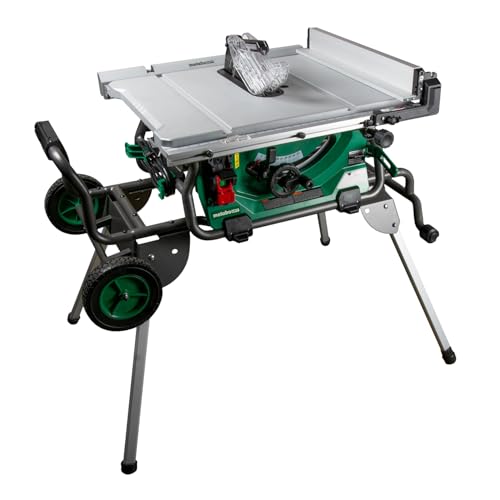
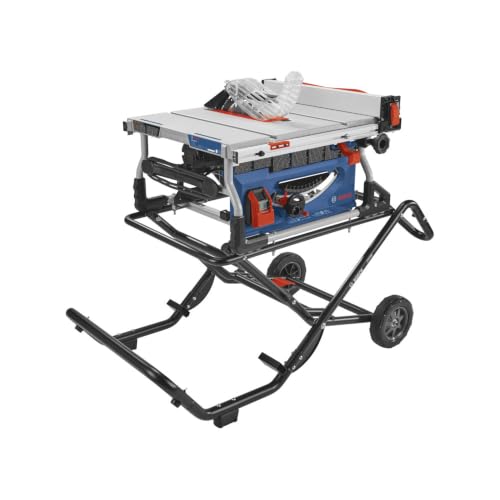
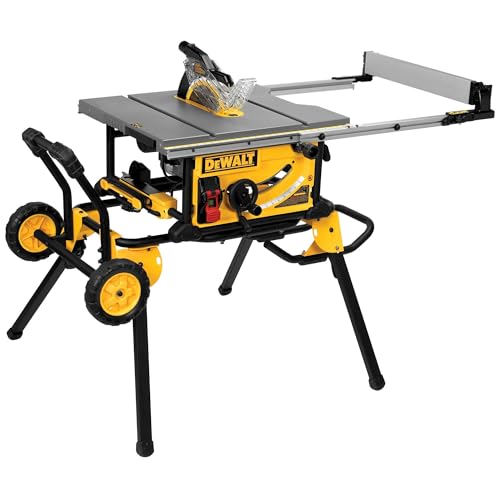
Cutting a 4x8 sheet of plywood, or a few boxes of laminate flooring, is one of the most common reasons people buy a table saw. It is also the job that exposes a saw’s weak points. A sheet is 48 inches wide and 96 inches long. The tables on the saws in this guide are roughly two feet across, so the saw does only part of the work. The rest is how you support the material.
This guide uses the makers’ published specifications and public safety guidance from OSHA. This is a desk guide, not a shop session, and we note where a maker leaves a figure out.
Rip Capacity: The Number That Matters First
Rip capacity is the distance from the blade to the fence, on the right side. To halve a 4x8 sheet lengthwise you need 24 inches. Here is what the makers list for the saws we cover:
- Metabo HPT C10RJS: 35 inches right, 22 inches left.
- DeWalt DWE7491RS: 32-1/2 inches.
- Bosch GTS15-10: 32-1/8 inches right, 14-1/8 inches left.
- Bosch 4100XC-10: 30 inches right, 8.5 inches left.
- SawStop Jobsite Saw PRO: 25-1/2 inches right, 9-3/4 inches left.
- Milwaukee M18 FUEL 2736-20: 24-1/2 inches (cordless).
- DeWalt FlexVolt DCS7485T1: 24 inches (cordless).
Extra capacity gives you room for cabinet sides, wide shelves and a bit of margin when the fence is not quite where you want it. But capacity is not the same as support, and that is where most sheet-cutting problems start.
Support: Infeed, Outfeed and Side
A sheet of plywood is much bigger than any of these tables. Without support, the sheet tips as it passes the blade, and a pinched or twisting board is how kickback starts. OSHA’s woodworking guidance says kickbacks, where the blade catches the stock and throws it back toward the operator, are a major cause of table saw injuries.
Plan the setup before you cut:
- Infeed: a table, sawhorses or roller stand at saw height behind where you stand.
- Outfeed: support at the same height past the blade, wide enough for the cut piece.
- Side support: for the off-cut that hangs to the left, since a heavy half-sheet can drag the whole panel off line.
- A helper: for the first long rip, to catch the piece, not to pull it.
Metabo HPT includes a rear outfeed support with the C10RJS and lists a telescoping table extension. Bosch lists an outfeed support and a left-side support among the accessories for the 4100XC-10. A stand with wheels is not an outfeed table, and we prefer a separate, rigid support.
If you plan to break down full sheets often, many woodworkers cut them to rough size with a circular saw or track saw first, then bring the smaller pieces to the table saw for accurate rips. It is easier on your back and on the saw.
Guarding Still Applies
Sheet goods do not change the rules. For through cuts, keep the blade guard, riving knife and anti-kickback pawls installed, use a push stick near the blade, stand to the side of the blade and guide the stock parallel to the rip fence, as OSHA’s table saw guidance recommends. Read the manual before the first cut and use the blade the maker specifies.
Laminate flooring and veneered plywood chip easily and dull blades quickly. Use a sharp, fine-tooth blade suited to the material and plan for dust: wear a respirator and eye and hearing protection, and connect the saw’s dust port to a vacuum. Neither a guard nor a brake makes up for a dull blade.
Metabo HPT C10RJS: Widest Rip
A 15-amp jobsite saw with 35 inches of rip capacity to the right of the blade, a telescoping table extension, a rear outfeed support and a fold-and-roll stand.
This is the saw to look at first if capacity is your top priority. Metabo HPT lists 35 inches to the right of the blade and 22 inches to the left, a 28-3/4 by 22 inch table, soft start and an electric brake. The stand folds and rolls.
There is a detail to check. The Metabo HPT page and tool card we read list a blade guard assembly and anti-kickback pawls but do not mention a riving knife or splitter, so open the owner’s manual before you buy and confirm how the guard attaches. See the full Metabo HPT C10RJS profile.
Bosch GTS15-10: Capacity With a Full Guard Set
32-1/8 inches of rip capacity, a rack and pinion fence, soft start and Bosch's Smart Guard System with riving knife, pawls and barrier guard, on a gravity-rise wheeled stand.
According to Bosch, the GTS15-10 has a 3,800 rpm, 15-amp motor, a depth of cut of 3-9/16 inches at 90 degrees, and Clampzone areas that let the tabletop serve as a light-duty work surface. Bosch lists an outfeed support and a left-side support among its compatible accessories, which fits the sheet-cutting job. Its brake is a convenience brake that helps the blade stop in about three seconds, not a skin-sensing system. Read the Bosch GTS15-10 profile for more.
DeWalt DWE7491RS: Telescoping Rack and Pinion Fence
A 15-amp jobsite saw with a 32-1/2-inch rip capacity, a rack and pinion telescoping fence and a rolling stand included.
DeWalt lists a 21-7/8 by 26-3/8 inch table, a flip-over ripping fence and onboard storage for the guard, fence, riving knife and miter gauge. The 32-1/2-inch capacity is enough to halve a sheet, but the rolling stand is not an outfeed table, so bring roller stands. DeWalt does not list a brake on the page we read. See our DeWalt DWE7491RS profile.
Bosch 4100XC-10: Wide Rip at a Manageable Weight
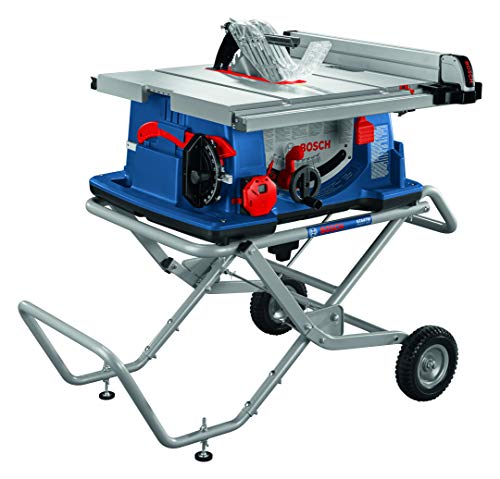
A 10-inch, 15-amp jobsite saw with a 30-inch rip capacity, a cast aluminum top and a gravity-rise stand, for splitting sheets in half.
The 4100XC-10 has a 30 by 22-1/2 inch cast aluminum top, a SquareLock fence and the Smart Guard System, according to Bosch. At 94 lb with the stand, according to Bosch, it is lighter than the 112 lb DeWalt lists for the assembled DWE7491RS. The Bosch 4100XC-10 profile has the details.
What About SawStop and Cordless Saws?
The SawStop Jobsite Saw PRO lists a 24-5/8 inch deep table and a 25-1/2-inch rip capacity, which is enough for a half-sheet. If you want a blade-contact brake and are ready to add support, read its profile. Cordless models are a fit for job sites without power, but their 24 to 24-1/2-inch capacity leaves little margin on a 4x8 sheet.
Bottom Line
For plywood sheets, rank saws by rip capacity and by how well you can support the sheet. The Metabo HPT C10RJS has the widest rip listed, and the Bosch GTS15-10 and DeWalt DWE7491RS follow with stands included. Buy roller stands or a support table along with any of them, and see our table saw comparison for all ten saws side by side.
Sources
Frequently asked questions
How much rip capacity do I need to cut a 4x8 sheet of plywood?
A sheet is 48 inches wide, so ripping it in half needs 24 inches to the right of the blade. Every saw we cover clears that: the cordless DeWalt FlexVolt lists 24 inches, the Milwaukee M18 FUEL 24-1/2, the SawStop Jobsite Saw PRO 25-1/2, the Bosch 4100XC-10 30, the Bosch GTS15-10 32-1/8, the DeWalt DWE7491RS 32-1/2 and the Metabo HPT C10RJS 35. Capacity only tells you where the fence can go. It does not support the sheet.
Can I cut a full 4x8 sheet on a jobsite table saw?
You can rip one with the right support, but the saws' tables are small next to a 4x8 sheet. Many woodworkers cut a sheet down to manageable pieces first with a circular saw or track saw, then finish on the table saw. Use sawhorses, roller stands or a support table at the same height as the saw table, and get a helper for the first long rip.
Do I need an outfeed table for plywood?
Yes, or an equivalent support. Bosch lists an outfeed support (TS1016) and a left-side support (TS1008) as accessories for the 4100XC-10, and Metabo HPT includes a rear outfeed support with the C10RJS. A roller stand or sawhorses set to table height can do the same job.
What blade should I use for plywood or laminate flooring?
Follow the saw's manual and the blade maker's guidance for the material. Fine-tooth blades are generally used on veneered plywood and laminate to limit chipping, and SawStop warns against very thin or very thick kerf blades on its portable saws. Laminate flooring dulls blades faster than solid wood.
Can I rip plywood on a cordless table saw?
The two cordless saws we cover, the DeWalt FlexVolt DCS7485T1 and Milwaukee M18 FUEL 2736-20, list 24 and 24-1/2 inches of rip capacity, enough to halve a 4x8 sheet. Milwaukee's 2736-20 is sold tool only, so battery and charger are extra. The DeWalt DCS7485T1 is a kit with one battery and a charger.
Is a brake worth having when cutting sheets?
A brake is a safety feature, not a sheet-handling feature. According to SawStop, its blade-contact brake works by sensing skin contact. Bosch's convenience brake only helps the blade stop sooner after power-off. Neither changes the need for support, a riving knife and a push stick.