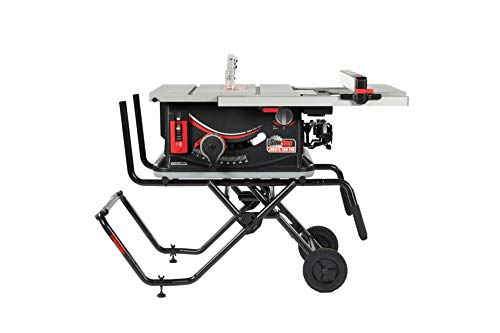
The SawStop Jobsite Saw PRO, model JSS-120A60, is SawStop’s portable table saw for people who want SawStop’s blade-contact brake without moving up to a stationary cabinet saw. It is a 10-inch, 15-amp, 120V saw that ships with a collapsible rolling cart, and SawStop positions it as a saw built for the worksite. This profile goes through what SawStop says about the saw, where it fits, where it does not, and what to know before you click through to Amazon.
The specifications below come from SawStop’s product page (an archived copy, since the live site blocks automated readers) and its FAQ. Anything SawStop does not publish, we leave out rather than guess.
What SawStop Says About the Jobsite Saw PRO
According to SawStop, the saw has these main specifications:
- Motor: 120 VAC, 60 Hz universal motor, 15 amps, 1.5 HP continuous and 4 HP peak.
- Blade: 10 inches, with a maximum depth of cut of 3-1/8 inches at 0 degrees and 2-1/8 inches at 45 degrees.
- Rip capacity: 25-1/2 inches to the right of the blade with the fence extended, 9-3/4 inches to the left.
- Table: 24-5/8 inches deep, 31-1/4 inches wide retracted and 43-3/8 inches wide extended.
- Weight: 84 lb for the saw alone and 113 lb with the cart.
- Cart dimensions: 48 by 29 by 36 inches open and ready to use, 26-1/2 by 29 by 45 inches when closed on end for storage.
- Bevel range: -1 to 46 degrees, with the blade tilting left.
- Cord: 116 inches.
- Warranty: two years, with saw registration.
SawStop lists a long set of included items: the cart, a high/low T-style fence with its Ergolock, a miter gauge, the Active Dust Collection Blade Guard, a riving knife, two blade wrenches, a push stick, a 10-inch blade, a zero clearance insert, a standard brake cartridge, a user’s guide and the hardware and hex keys. That is a complete kit.
The Brake, in SawStop’s Words
The reason to look at a SawStop is the safety system. SawStop says its patented system stops a spinning blade on contact with skin, that the blade stops in less than 5 milliseconds and drops below the table, and that this can reduce a potentially life-altering injury to what it calls a mere scratch. That is SawStop’s description, and it is worth reading with its FAQ beside it. In the FAQ, SawStop says that in the vast majority of cases, contact with the spinning blade results in a minor cut, but that if your hand moves into the blade at very high speed, a serious injury is still possible. It also says the saw continuously runs self-checks and will not let the motor start, or keep running, unless every component of the safety system is working.
A few points from the FAQ that matter in daily use:
- After the brake fires, the cartridge must be replaced. SawStop says replacing it is simple and can take as little as 90 seconds, but you will also need to evaluate the blade, because activation can damage teeth.
- Gloves are a bad idea. SawStop says not to wear gloves on its saws, because a glove can snag on the blade and pull your hand in at high velocity.
- Blade choice matters. SawStop says non-conductive blades or blades with non-conductive hubs or teeth should not be used, because they prevent the system from sensing skin contact. It also warns against very thin or very thick kerf blades and against blades more than 1/16 inch over the specified size on its portable saws.
- Wet wood can trigger the brake. According to SawStop, most wet wood is fine, but wood that is wet enough to spray a mist when cut, or wet and pressure treated, may be conductive enough to activate the brake. If you are unsure whether a material is conductive, check the manual or contact SawStop before cutting it.
- Use the guard. SawStop says it strongly recommends using a blade guard whenever possible.
The brake is one layer, not a license to relax. OSHA’s woodworking eTool notes that kickbacks, where the blade catches the stock and throws it back toward the operator, are a major cause of table saw injuries, and a brake that watches for skin contact does not stop a workpiece from being thrown. For that, use the riving knife, keep the blade guard on, stand to the side of the blade line and feed stock parallel to the fence.
Table, Fence and Dust Collection
SawStop calls the 24-5/8-inch table depth class-leading for a jobsite saw, and the number is large enough to matter: a deeper table supports the board longer as it moves toward the blade. The fence is a high/low T-style design with SawStop’s Ergolock. SawStop says it slides easily and locks with one touch, and the low face gives extra clearance for thin rips and small parts. The extendable shelf adds support for wider material.
Blade elevation is a one-turn system according to SawStop: a single turn of the handwheel raises or lowers the blade through its range. Quick-Tilt bevel adjustment moves the blade in 1-degree increments.
Dust is a real concern with any table saw, and SawStop gives this model two answers. The Active Dust Collection Blade Guard is a polycarbonate guard that captures dust above the table, and an internal shroud handles dust below. The guard ports are small (1-11/16 inches outside for the guard, 2-9/16 inches outside for the main port), so plan on a shop vacuum with the right adapters. SawStop’s page also carries a California Proposition 65 warning about wood dust, so wear a respirator rated for fine dust however you collect it.
Mobility and Storage
The cart is part of the saw. A foot pedal extends it for use and collapses it for transport, and SawStop says the saw is sold with the cart only. At 113 lb with the cart, it is a two-person lift into a truck bed unless you use a ramp, and it is noticeably heavier than the 68 lb SawStop Compact Table Saw. The closed cart footprint of 26-1/2 by 29 inches makes it easy to store on end in a garage corner. The onboard drawer holds the guard, riving knife, miter gauge and other accessories, so nothing gets left on the job.
Who the Jobsite Saw PRO Fits
This saw is a sensible match for you if several of these are true:
- You want SawStop’s brake and need a saw you can roll through a doorway and store in a corner.
- You make a lot of ripping cuts on boards and sheet goods up to about 25 inches wide.
- You are comfortable paying more up front and replacing a brake cartridge if it ever fires.
- You want dust collection built into the guard rather than added later.
Who Should Look Elsewhere
- You carry the saw up stairs or into a truck every day. 84 lb for the body alone is heavy. The lighter SawStop Compact Table Saw at 68 lb, or a jobsite saw in the Bosch and DeWalt class, is easier on the back.
- You need a bigger table and rip capacity. For wide rips and long runs, a stationary saw such as the SawStop Contractor Saw CNS175 offers more room.
- You are on a tight budget. The Jobsite Saw PRO sits at the top of the jobsite class, and the brake adds a cost after any activation.
- You often cut very wet or pressure-treated lumber. Read SawStop’s guidance on conductive material before buying.
Set-Up Habits Worth Building from Day One
Whatever saw you buy, a few habits cost nothing. Keep the blade guard, riving knife and anti-kickback features installed for through cuts. Use a push stick for narrow stock, as OSHA’s table saw guidance advises. Stand to the side of the blade, not in line with it. Never reach over the spinning blade. Read the manual, including the sections on installing the cartridge and blade. Register the saw, because SawStop’s two-year warranty is tied to registration. Finally, keep a spare brake cartridge on hand if you work in a place where a delay would cost you a day.
What the Federal Safety Regulator Says
The Consumer Product Safety Commission has proposed a rule on blade-contact injuries on table saws. In its November 1, 2023 supplemental notice of proposed rulemaking, CPSC says there were an estimated 26,500 emergency department-treated blade-contact injuries from table saws in 2017, and that an estimated 25,600 of them involved the finger. This is a proposed rule, and we do not describe its current status here. SawStop’s FAQ says the proposal does not mandate SawStop’s technology. The numbers are a reminder of why guard use and safe habits matter on every saw, with or without a brake.
Bottom Line
The SawStop Jobsite Saw PRO is a premium, portable 10-inch saw for people who value SawStop’s brake and who can live with the weight and the extra cost of ownership. It has a deep table, a high/low fence, a built-in cart and onboard storage. It is not a light saw, and it is not the cheapest way to get a jobsite table saw. Use the button below to see the current price and kit on Amazon, and compare it with the neighboring models, such as the SawStop Compact Table Saw and the Bosch GTS15-10.
See price on Amazon
See how it ranks in our table saw comparison.
Sources