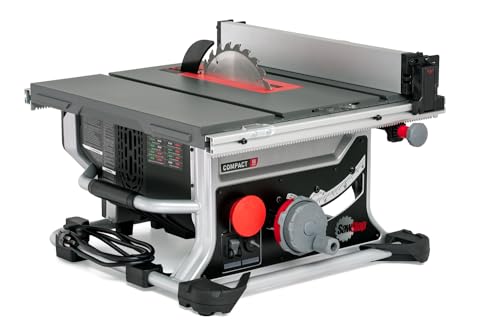
The SawStop Compact Table Saw, model CTS-120A60, is the lightest way into SawStop’s blade-contact brake. It is a 10-inch, 15-amp, 120V benchtop saw that SawStop calls the smallest and most portable saw in its lineup. If the SawStop Jobsite Saw PRO is too heavy for you and the Contractor Saw is too large, this is the saw in between.
This profile covers SawStop’s published specifications, the trade-offs that come with the compact design, and who should consider it. The specifications come from SawStop’s product page (an archived copy, because the live site blocks automated readers) and its FAQ. We do not give figures that SawStop does not publish.
What SawStop Says About the CTS
According to SawStop, the CTS has:
- Motor: 120 VAC, 60 Hz universal motor, 15 amps, with a no-load speed of 4,000 rpm.
- Blade: 10 inches, with a maximum depth of cut of 3-1/8 inches at 0 degrees and 2-1/8 inches at 45 degrees.
- Rip capacity: 24-1/2 inches to the right of the blade and 9-1/2 inches to the left.
- Table: 23 inches wide by 22-5/8 inches deep.
- Weight: 68 lb. Overall footprint is 14-1/4 inches high by 23-1/2 inches wide by 27 inches deep.
- Dust port: 2-1/2 inches.
- Fence: a high/low rack and pinion fence with built-in high and low faces.
- Bevel: a Quick-Tilt system with micro-adjustment that SawStop says is exclusive to its saws.
- Warranty: two years with registration.
Included items, according to SawStop, are a miter gauge, the brake cartridge (installed), a riving knife (installed), a blade guard with a spreader and anti-kickback pawls, a 24-tooth ripping blade (installed), a push stick, a standard lockdown insert, two blade wrenches and a hex key. Having the guard, spreader, pawls and riving knife in the box is a point in the saw’s favor, because that is the set of protections you should leave in place on through cuts.
The Brake, in SawStop’s Words
SawStop says its patented safety system stops a spinning blade on contact with skin, that the blade stops in less than 5 milliseconds, and that it drops below the table, reducing what could be a life-altering injury to what SawStop calls a mere scratch. That is the manufacturer’s description. The FAQ is more cautious: in the vast majority of cases the result of blade contact is a minor cut, but a hand moving into the blade at very high speed can still be seriously injured. SawStop also says its system self-checks and will not let the motor run unless the system is working.
The FAQ lists several practical rules for living with the brake:
- Replace the cartridge after it fires. SawStop says activation can damage blade teeth, so the blade should be checked or replaced too.
- Do not wear gloves, since a glove can snag on the blade and pull your hand in at high speed.
- Avoid non-conductive blades, very thin or very thick kerfs, and blades more than 1/16 inch over the specified size on SawStop’s portable saws, because the blade-to-brake gap on these models is not adjustable.
- Know that very wet or green wood, or wet pressure-treated wood, may be conductive enough to activate the brake. Check the manual or call SawStop before cutting a material you are unsure about.
None of that replaces ordinary shop discipline. Keep the guard, riving knife and anti-kickback pawls installed for through cuts. OSHA’s woodworking guidance says to use a push stick for small pieces of stock, to stand to the side of the blade in case of kickback and to guide stock parallel to the rip fence. Read the manual before the first cut.
Portability and the Benchtop Design
SawStop highlights two ways to carry the saw: a handle you grab like a suitcase, or two-handed grips on each side of the table. At 68 lb, it is still a heavy item, so think about stairs, truck beds and who will help. A rigid tube structure and rubber feet are meant to keep it stable on a bench.
The catch is that the saw is a benchtop design. SawStop sells a folding stand, the CTS-FS, separately, and that is the likely partner if you plan to move the saw between sites. If you do not buy it, you need a stable bench at a comfortable height with a way to clamp or secure the saw. Plan for outfeed support too, since the table is only 22-5/8 inches deep and a long board needs help from a roller stand or support table.
Where the Compromises Are
The CTS gives up several things to reach 68 lb, and SawStop is open about most of them:
- No dado. SawStop says dado stacks are too heavy for the saw’s drivetrain and structure.
- Multi-turn elevation. The Jobsite Saw PRO has a one-turn system, while the CTS uses a multi-turn handwheel.
- Smaller table and a bit less rip capacity. 24-1/2 inches versus 25-1/2 for the Jobsite Saw PRO. For sheet goods, you will want solid infeed and outfeed support.
- Basic dust collection. SawStop lists a 2-1/2-inch port and a standard guard. The Jobsite Saw PRO has an active dust collection guard. Plan on a shop vacuum with the right fitting and wear a respirator for fine dust.
On the other side of the ledger, the CTS is the lightest SawStop, the fence is a rack and pinion that SawStop says is easy to adjust and reliably square, and it has a storage compartment on the saw for the accessories.
Who the Compact Table Saw Fits
- You want SawStop’s brake in the lightest possible package, for example because you rent or have a small shop.
- You do trim, shelving, small furniture and cabinet parts rather than daily sheet-good breakdown.
- You are willing to buy or build a stand, and you have help for the occasional lift.
- You are replacing an older jobsite saw and want to add a brake at the same time.
Who Should Look Elsewhere
- You break down full sheets regularly. A saw with more table and a wider rip, such as the Bosch GTS15-10 at 32-1/8 inches according to Bosch, handles that work with less fuss.
- You need dado capability. SawStop says to look at the Jobsite Saw PRO.
- You want a stand and cart in the box. The Jobsite Saw PRO has a built-in cart, and the Bosch and DeWalt jobsite saws on our ranking ship with a stand.
- You are on a tight budget. SawStop’s brake is a premium feature, and the saw has a replacement cartridge as an ongoing cost.
Bottom Line
The SawStop Compact Table Saw is for people who care about SawStop’s brake and portability more than table size or rip capacity. It is a strong match for a small shop, a homeowner with limited storage or a trim carpenter who can live with a benchtop saw and a separate stand. It is not the best choice for dado work or large sheet goods. Use the button below to see the current price and what is included on Amazon, and read our profiles of the SawStop Jobsite Saw PRO and Bosch GTS15-10 for the alternatives.
See price on Amazon
See how it ranks in our table saw comparison.
Sources