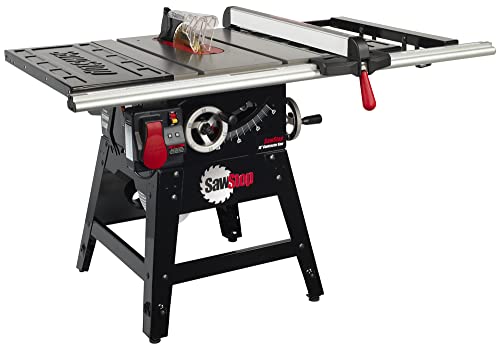
The SawStop Contractor Saw CNS175 is a stationary 10-inch saw with a cast iron table and SawStop’s blade-contact brake. The Amazon listing we link here is the CNS175-SFA30, which pairs the saw with a 30-inch Standard Fence Assembly. Despite the name, this is not a portable jobsite saw. It is the entry point into SawStop’s cast iron line, and it is aimed at garage shops, serious hobbyists and small cabinet and furniture makers who want a 120V machine that can grow with them.
This profile covers what SawStop says about the saw, where the details change depending on the fence, who it suits, and who should consider something lighter.
A Note on the Fence Version
SawStop’s product page for the Contractor Saw shows the CNS175 line with a 30-inch Premium Fence, and a number of figures on that page, such as a 30-inch rip to the right of the blade and a 12-inch rip to the left, are given with that premium fence. The product we link is the 30-inch Standard Fence version. SawStop’s FAQ describes it this way: the 30-inch rip choice includes a Standard Fence Assembly that locks on both the front and rear rail. We do not carry premium-fence specifications over to this saw, so the rip capacity figures are for you to confirm on the Amazon listing and in SawStop’s Standard Fence manual.
What SawStop Says About the Saw Itself
The saw body specifications on SawStop’s page apply to the CNS175 line:
- Motor: 1.75 HP, 120V, 14 amps. SawStop says the motor can be rewired to 220V with an optional kit.
- Blade: 10 inches, with a 5/8-inch arbor. Maximum depth of cut is 3-1/8 inches at 0 degrees and 2-1/4 inches at 45 degrees. The blade tilts to the left.
- Table: cast iron, 20 by 27 inches on its own. SawStop lists extension wings of 12 by 27 inches in stamped steel, with cast iron wings sold separately, and a combined width of 44 inches with both wings.
- Weight: 225 lb for the table saw only, according to SawStop. The page lists a shipping weight of about 240 lb for the saw alone, and SawStop’s FAQ says the heaviest box, with the saw body, weighs about 205 lb.
- Dust port: 4 inches.
- Riving knife: 0.090 inch (2.3 mm) thick.
- Blade guard: a standard polycarbonate guard that extends 1 inch to the right of the blade, with an optional dust collection guard for purchase.
- Warranty: two years with saw registration.
SawStop lists included items on its page, among them a miter gauge, a micro blade guard, a riving knife, a push stick, a 10-inch blade, a standard lockdown insert, a standard brake cartridge and the owner’s manual. Because the page describes the premium fence package, confirm the exact box contents on the Amazon listing.
How the Safety System Is Described
SawStop says its patented system stops a spinning blade on contact with skin, that the blade stops in less than 5 milliseconds and drops below the table, and that this can reduce a potentially life-altering injury to a minor one. SawStop says a control box houses the on-off switch, the power paddle and an on-board computer that constantly checks that all systems are working. Per the FAQ, the safety system will not let the motor start or keep running unless every component is working.
SawStop also says plainly that a serious injury is still possible if a hand moves into the blade at very high speed, and that you should use a blade guard whenever possible and avoid gloves. It lists a few practical limits too: non-conductive blades should not be used, blades with a very thin or very thick kerf are outside the design range, and very green or wet wood, or wet pressure-treated wood, may be conductive enough to trigger the brake. If a brake fires, the cartridge has to be replaced and the blade checked.
On every table saw, the basics apply. Keep the guard, riving knife and anti-kickback features on for through cuts. OSHA’s woodworking guidance says to use a push stick for small pieces, to stand to the side of the blade to avoid injury from kickback and to guide stock parallel to the rip fence. A brake that responds to skin contact does not stop a board from kicking back, so these habits still matter.
Why a Contractor Saw Instead of a Jobsite Saw
A stationary saw does a few things that a portable saw cannot. It is heavier, so it vibrates less. Its table is bigger and flatter, which helps you support a long board. SawStop lists its table flatness (measured diagonally) at a maximum gap of 0.016 inch and its arbor runout at a maximum of 0.001 inch, which are manufacturer tolerances rather than figures verified independently. A V-ribbed, static-dissipative belt drives the arbor, and SawStop says a cast iron table gives better-than-hybrid performance.
The other draw is configurability. SawStop says there are over 150 possible configurations, from a mobile base to a sliding crosscut table to a router table. A few compatibility notes in SawStop’s FAQ are worth knowing before you plan the shop: the folding outfeed table is not compatible with the Contractor Saw, and the saw’s mobile base does not work with the inline router table.
Set-Up and Delivery
Plan for the weight. SawStop says the saw body ships in a box of 35 by 30 by 20 inches that weighs about 205 lb, and that the fence and rails ship in additional boxes. You will want a helper, a dolly and a clear path to the shop. Assembly involves the fence rails, wings and guard, and the manual and the quick start guide cover it. If you are converting the motor to 220V, hire a licensed electrician. Do not wire a 240V circuit yourself.
SawStop’s FAQ also suggests consulting an electrician about breaker size for any of its saws, so talk to one before you run a dedicated circuit to a garage.
Who the CNS175 Fits
- You have a garage or shop with floor space and a 120V circuit and you want SawStop’s brake on a stationary saw.
- You rip and crosscut boards and sheet goods regularly, and you want a larger, steadier table than a jobsite saw gives you.
- You want to add a router table, sliding table or mobile base later, and a cast iron saw gives you that path.
- You like the idea of a machine you can keep for years and tune.
Who Should Look Elsewhere
- You need to move the saw between job sites. The 84 lb SawStop Jobsite Saw PRO or the 68 lb SawStop Compact Table Saw are built for transport.
- You are not sure you will keep woodworking. A premium stationary saw is a long-term purchase, and a lighter jobsite saw may fit better while you find out.
- You want the lightest possible saw for occasional projects. A stationary saw takes real floor space, and the weight is a commitment.
- You have a very small garage. The saw’s overall footprint with the 30-inch fence systems is 61-3/4 by 40-1/2 inches, before you add outfeed space.
Bottom Line
The SawStop Contractor Saw CNS175-SFA30 is a premium, stationary 10-inch saw for people with a real shop and a long horizon. It combines a 120V motor, a cast iron table and a large accessory catalog with SawStop’s blade-contact brake. Its main limits are weight, cost and a fence package that is not the one shown on SawStop’s main page, so check the listing carefully. Use the button below to see the current price and what is in the box on Amazon. For a lighter, portable alternative, read our SawStop Jobsite Saw PRO profile.
See price on Amazon
See how it ranks in our table saw comparison.
Sources