We earn a commission if you buy through our links, at no extra cost to you.
Best Table Saw for Home Use: Garage Shop Picks
Choosing a table saw for a garage or home shop: stationary vs jobsite, 120V circuits, space, dust and guarding, plus four saws worth a look.
At a glance
For a home shop with floor space, the SawStop Contractor Saw CNS175-SFA30 is a stationary 120V saw with a blade-contact brake. If you need to roll the saw away, the SawStop Jobsite Saw PRO adds a built-in cart, and the Bosch GTS15-10 offers 32-1/8 inches of rip capacity with its own wheeled stand.
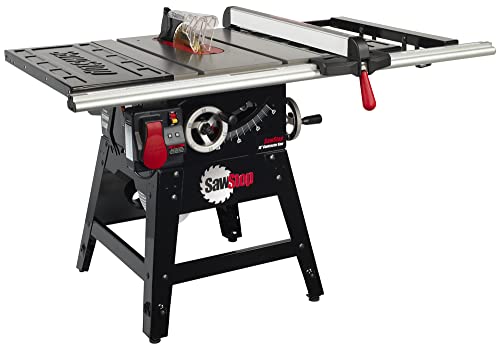
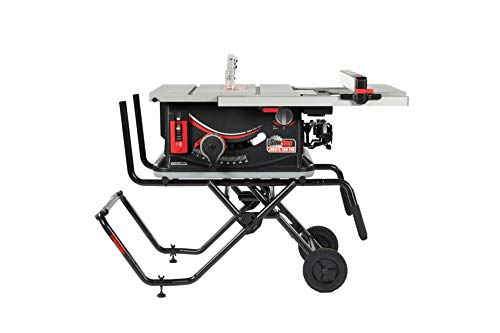
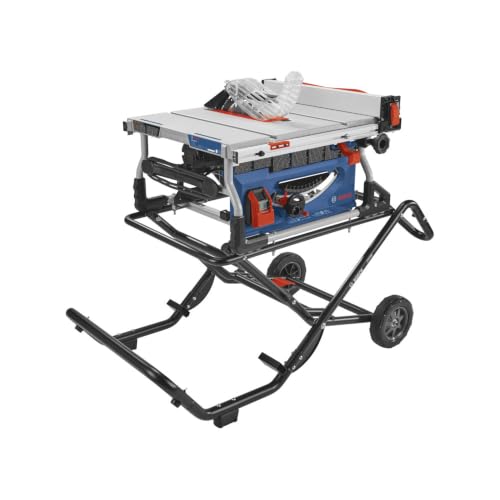
A table saw is the machine most home woodworkers build their shop around, and it is also the one that takes the most space, the most power and the most respect. Before you pick a model, three things decide what fits: how much room your garage or basement really has, what circuit you can feed it from, and whether the saw has to move out of the way when you are done.
This is a desk guide, built from the makers’ published specifications, from SawStop’s own pages and FAQ (archived copies, because the live site blocks automated readers), from OSHA’s woodworking guidance and from the Consumer Product Safety Commission’s proposed rule on table saws. We say when a maker leaves a detail out. Each pick below links to its full profile.
Stationary or Jobsite: The First Decision
A stationary saw is a shop fixture. It is heavy, so it vibrates less, and its table is larger, which helps when you support a long board. A jobsite saw is lighter, folds or rolls, and costs you some table size and a little precision in exchange for being able to disappear into a corner.
- Pick stationary if you have a dedicated bay, you plan to add a router table or mobile base later, and you want a machine you can tune and keep for years.
- Pick a jobsite saw if the garage is shared, if you work in the driveway on nice days, or if you also do repairs and installs away from home.
Weight tells the story. SawStop lists the Contractor Saw at 225 lb for the saw alone, and says the heaviest shipping box weighs about 205 lb. Bosch lists the GTS15-10 at 91 lb. SawStop lists the Jobsite Saw PRO at 84 lb for the saw and 113 lb with its cart. Plan for a helper and a clear path either way.
Power, Circuits and Plugs
Every saw in this guide runs on 120V, which is the point: you do not need a special outlet to get started. SawStop lists the Contractor Saw at 1.75 HP and 14 amps, the Jobsite Saw PRO at 15 amps, and Bosch lists the GTS15-10 at 15 amps with soft-start circuitry. Bosch says soft start manages the intensity of motor start-up, which can help on a shared circuit.
Even so, a saw that draws that much current should not share a circuit with a window air conditioner, a compressor or a dust collector. SawStop says the Contractor Saw’s motor can be rewired for 220V with an optional kit, and its FAQ suggests consulting an electrician about breaker size. Have a licensed electrician handle any 240V circuit or new run to the garage, and do not attempt the conversion yourself.
Dust, Noise and the Rest of the Shop
Wood dust is more than a nuisance. SawStop’s page carries a California Proposition 65 warning about it, so plan on a shop vacuum or dust collector connected to the saw’s port and wear a respirator rated for fine dust. Dust port sizes differ. SawStop lists a 4-inch port on the Contractor Saw, and 2-9/16 inches on the Jobsite Saw PRO’s main port, so check that your hose and fittings match before you buy.
Saws are loud. Wear hearing and eye protection every time, and think about neighbors if your shop shares a wall.
Guarding and Safe Habits
The saws below ship with protections, and the way to get value from them is to leave them on. For through cuts, keep the blade guard, riving knife and anti-kickback pawls installed. OSHA’s woodworking guidance says kickbacks, where the blade catches the stock and throws it back toward the operator, are a major cause of table saw injuries, and it recommends a push stick for small pieces, standing to the side of the blade and guiding stock parallel to the rip fence. Read the manual before the first cut.
The CPSC’s 2023 supplemental notice of proposed rulemaking, which is a proposed rule, estimates 26,500 table saw blade-contact injuries treated in emergency departments in 2017. That number is a reminder that the brake question is worth thinking about, not a promise that any one saw prevents injury.
SawStop Contractor Saw CNS175-SFA30: The Shop Saw
A stationary, cast iron 10-inch saw on a 120V circuit with SawStop's blade-contact brake, for a garage shop that can spare the floor space.
If you have the room, this is the saw to start with. SawStop lists a 1.75 HP, 14-amp, 120V motor, a 10-inch blade with a 3-1/8-inch depth of cut at 0 degrees, a cast iron table and a standard power cord. It describes more than 150 possible configurations, from a mobile base to a router table, which matters if your shop will grow.
SawStop says its brake stops the blade in less than 5 milliseconds on skin contact, and that the system self-checks before the motor will run. SawStop’s FAQ also says a serious injury is still possible if a hand moves into the blade at very high speed, and that the cartridge, and often the blade, must be replaced after the brake fires. Our profile of the Contractor Saw covers the details.
One caution: SawStop’s main page shows the 30-inch Premium Fence version. The saw we picked is the SFA30 with the 30-inch Standard Fence, so confirm rip capacity on the listing and do not assume the premium-fence figures apply.
SawStop Jobsite Saw PRO: For a Shared Garage
SawStop's brake in a 120V, 15-amp portable saw that comes with a folding rolling cart, a riving knife and an onboard storage drawer.
If the garage has to double as parking, the Jobsite Saw PRO gives you the same blade-contact brake in a package that rolls away. According to SawStop, it has a 24-5/8 inch deep table, a 25-1/2-inch rip capacity to the right of the blade, an Active Dust Collection Blade Guard and a riving knife, and it is sold only with the cart. The cart folds and stores on end.
The trade-off is cost of ownership and weight. At 113 lb with the cart, it is heavy for a portable saw, and the brake cartridge is a replaceable part. See our Jobsite Saw PRO profile for the full specifications.
Bosch GTS15-10: Wide Rip, Own Stand
A 15-amp jobsite saw with 32-1/8 inches of rip capacity, a rack and pinion fence and a gravity-rise wheeled stand, for a home shop that wants capacity without a brake premium.
The GTS15-10 is the practical choice when you want a wide rip and a stand in one purchase. Bosch lists 32-1/8 inches to the right of the blade, a rack and pinion fence, soft start and a Smart Guard System with a three-position riving knife, anti-kickback pawls and a barrier guard. The wheeled stand sets up in a single action, according to Bosch.
Be clear about the brake. Bosch calls it a convenience brake that helps the blade stop in about three seconds after power-off. It does not detect skin contact. If that matters to you, the SawStops above are the saws to consider. Our Bosch GTS15-10 profile has the rest.
A Benchtop Option for a Tight Space
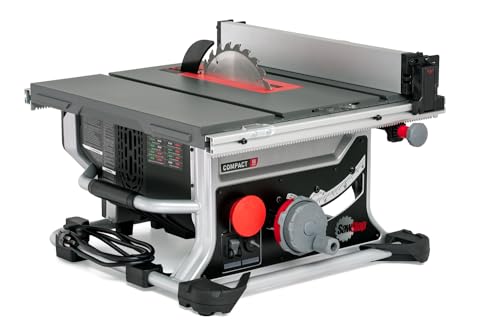
SawStop's lightest saw, a 120V benchtop model with the blade-contact brake, for a small shop with a sturdy bench or a separate stand.
If you only have room for a saw that lives on a workbench, SawStop’s Compact Table Saw weighs 68 lb according to SawStop and carries the same style of brake. It is a benchtop model, so SawStop’s folding stand is a separate purchase, and SawStop says it cannot use dado blades. Read our profile of the Compact Table Saw if space is your biggest limit.
Which One Should You Choose?
- Dedicated garage bay, long-term shop: the SawStop Contractor Saw CNS175-SFA30.
- Shared garage, want a brake and a cart: the SawStop Jobsite Saw PRO.
- Want capacity and a stand, and are comfortable without a skin-sensing brake: the Bosch GTS15-10.
- Very little room: the SawStop Compact Table Saw on a bench or stand.
Our table saw comparison lists all ten saws side by side. Whichever you choose, budget for the extras: blades, a push stick, dust collection, support for long boards and the replacement brake cartridge if you pick a SawStop.
Sources
- SawStop Contractor Saw product page (archived copy)
- SawStop Jobsite Saw PRO product page (archived copy)
- SawStop Compact Table Saw product page (archived copy)
- SawStop FAQs (archived copy)
- Bosch GTS15-10 official product page
- CPSC supplemental notice of proposed rulemaking, Federal Register, November 1, 2023
- OSHA Woodworking eTool: Kickbacks
- OSHA Woodworking eTool: Table Saws
Frequently asked questions
Should I buy a stationary saw or a jobsite saw for a home shop?
It comes down to floor space and how often you will move the saw. A stationary saw such as the SawStop Contractor Saw CNS175 is heavy (SawStop lists 225 lb for the saw alone) and stays put. A jobsite saw such as the Bosch GTS15-10 rolls on its own stand and folds away, which suits a garage that also has to hold a car.
Will a table saw run on a normal garage circuit?
The saws we picked are 120V models. The SawStop Jobsite Saw PRO and the Bosch GTS15-10 are listed at 15 amps, and the SawStop Contractor Saw at 14 amps. A saw that size should not share a circuit with other large loads. Ask a licensed electrician about breaker size and any new circuit.
Do I need a brake on a home table saw?
A brake is a feature choice, and we make no claim about what any rule requires. SawStop's saws use a blade-contact brake that SawStop says stops the blade in under 5 milliseconds. The Bosch GTS15-10 has a convenience brake that only helps the blade stop in about three seconds after power-off and does not sense skin. The Consumer Product Safety Commission's 2023 proposed rule estimated 26,500 table saw blade-contact injuries treated in emergency departments in 2017.
What do I need besides the saw?
A push stick, a shop vacuum or dust collector that fits the saw's dust port, hearing and eye protection, a respirator for fine dust, and infeed and outfeed support for long boards. Check the manual for the right blade and keep the guard, riving knife and anti-kickback pawls installed for through cuts.
Can I use a table saw on a bench in a small garage?
SawStop's Compact Table Saw is built as a benchtop model (68 lb, per SawStop) and its folding stand is sold separately. Whatever the saw, it must sit on a stable, level surface and be secured the way the manual says.
Are cordless table saws good enough for a home shop?
They suit trim, shelving and small projects where an outlet is far away. Corded 120V saws list wider rip capacities, and the cordless models we ranked list 24 and 24-1/2 inches according to their makers.